Encoder – Signal evaluation
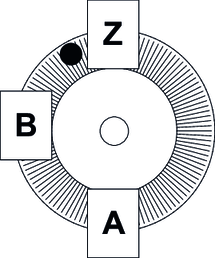

- Encoders, often called incremental encoders, are sensors for detecting changes in angle or position.
- Depending on the sensor type and desired resolution, they can use photoelectric or magnetic scanning:
- With optical scanning, a disk with a fine grid is scanned using optical signals.
- Magnetic scanning involves scanning a pole wheel or magnetic tape that has been magnetically inscribed with increments.
- The encoder has 2 sensors, track A and track B for scanning, and track Z for detecting one revolution.
- The sensors are arranged at an angle of 90 degrees to each other on the system being scanned.
- When the system rotates, the track A and track B sensors emit a defined number of pulses. These correspond to the angle or distance traveled. The direction of rotation can be determined based on the electrical phase shift of the two signals.
- If the shaft turns to the right, the signal from track A leads the signal from track B by 90°.
- If the shaft turns to the left, the signal from track A lags behind the signal from track B by 90°.
- When evaluating the sensors, the speed and direction can be determined from the difference between two counter readings.
- With single-factor evaluation, a 0–1 edge from track A or an increment of the system being scanned corresponds to a counter pulse.
- With 4-factor evaluation, a signal edge from track A and track B corresponds to one counter pulse. 4-factor evaluation is very frequently used.
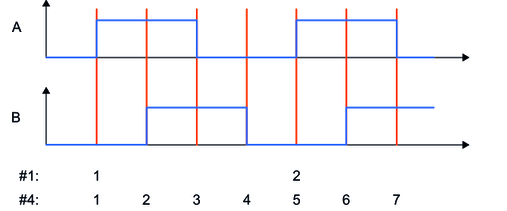
# 1 | Single-factor evaluation |
# 4 | 4-factor evaluation |
