Effect of load torque on the hoist
In a gravity-loaded axis, the test torque is composed of the motor torque and the load torque. To ensure that a brake is tested correctly with the desired test torque, the existing load torque of the application must be taken into consideration when integrating a brake test. Otherwise, the brake may be tested with a torque that is too high or too low. A test torque that is too high can cause undesired slippage of the closed brake, despite the brake being free of faults. The fault response that this triggers in the brake test can cause the machine to come to an undesired standstill and necessitate subsequent inspection and maintenance work. A test torque that is too high can also lead to an undesired load on the machine structure.
By contrast, a brake with a test torque that is too low will not be sufficiently tested. Potential faults could go undetected and lead to loss or limitation of the desired safety.
The following figure shows a simplified representation of the torques on the hoist with a load torque in the direction of gravity. The representation of the torques is idealized, e.g. without friction forces or rolling resistance.
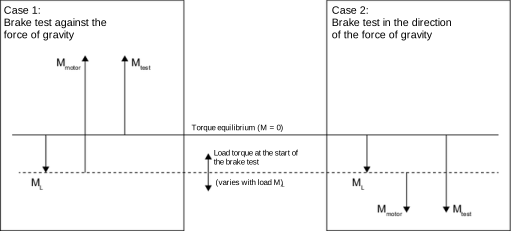

Mtest | Total torque used to test the brake |
ML | Portion of Mtest made up of load torque |
Mmotor | Portion of Mtest made up of motor torque |
The portion of the desired test torque made up of the motor torque amounts to:
Case 1: |
|
Case 2: |
|


To test the brake, the axis can also be loaded with a defined testing weight. The mass of the testing weight corresponds to the equivalent motor torque. The load torque is assumed to be constant or must be determined and taken into consideration each time the brake test is performed. In applications with variable load torques, a brake test with integrated load determination is recommended.
