Direct referencing
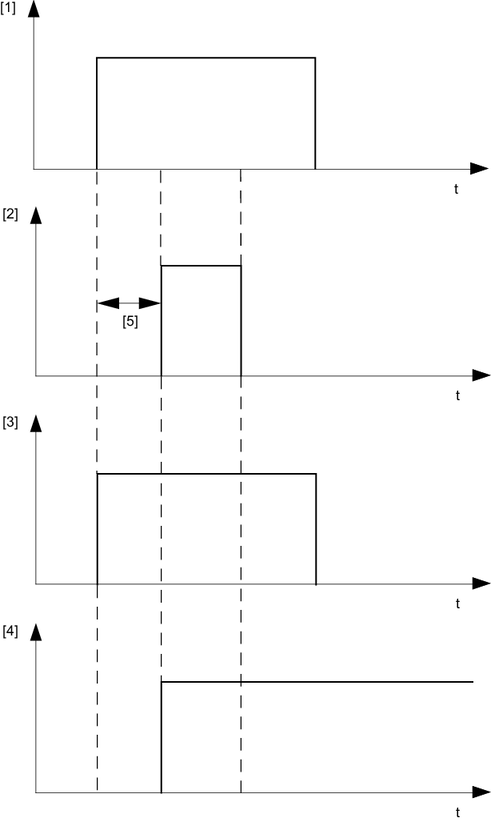

[1] | Selection and activation via the "Direct referencing" bit |
[2] | Execution of the "Direct referencing" bit |
[3] | "Referencing active" bit |
[4] | "Referenced" bit is active |
[5] | Min. 10 ms; max. 60 s |
With direct referencing, the reference position is entered in the "Assist CS.." parameterization tool. The offset is calculated when activating (0 → 1 edge) direct referencing.
During referencing, the drive must be in an idle state and the position must not move by more than the parameterized positional tolerance (basic settings) for 500 ms.
The direct referencing function can be activated by the following sources:
- F-DI (function assignment)
- Safe process output data (referencing)
Direct referencing is activated via safe communication using the "Activate direct referencing" bit (byte 4, bit 4). After direct referencing is selected, it must be executed within 60 seconds; otherwise, a warning message is displayed and direct referencing must be selected again. As soon as referencing is active, the "Referencing active" bit (byte 5, bit 4) is set to TRUE, while the "Referenced" bit (byte 5, bit 5) retains its status. Setting the “Execute direct referencing” bit (byte 4, bit 5) activates secure direct referencing. If no errors occur, the new reference offset is saved in the safety option. The "Referencing active" bit is then set to FALSE. The "Referenced" bit remains or is set to TRUE. Afterward, the "Select direct referencing" and “Execute direct referencing” bits can be set to FALSE. If an error occurs during referencing, this is reported and the "Referenced" bit is set to FALSE.
If a safe digital input (F-DI) has been assigned, the bits of the safe process output data (F-PO) are not evaluated.
No referencing data is saved in the safety option if direct referencing is interrupted. All the encoders that are to be referenced via direct referencing are subsequently not referenced. The "Referenced" bit is logically "0" afterwards.
