Product description
In many areas of application, there are situations in which regenerative travel sections emerge, e.g. due to a vertical drive moving downwards or a horizontal drive slowing down.
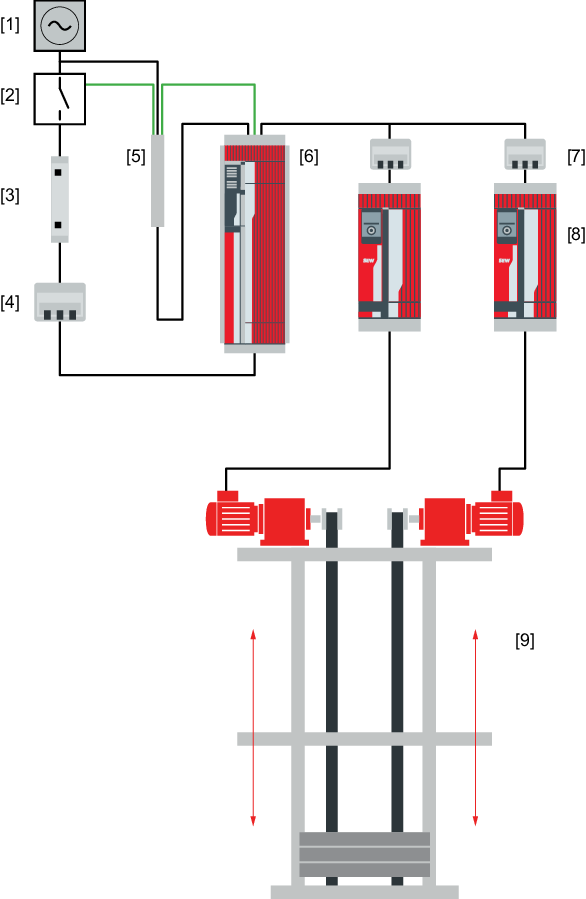
In these regenerative travel sections, the motor feeds energy back into the device's DC link which leads to an increase of the DC link voltage. In a few cases, the regenerative energy is so low that it can be stored in the device's DC link capacities. Generally, the energy is converted to heat energy via a braking resistor and the system consequently loses it.
To prevent this loss of energy, there is the option of feeding the regenerative energy back into the supply system. This makes the regenerative energy available to other consumers. and saves energy and costs during operation.
If the following points apply, the regenerative power supply of the regenerative energy into the grid is especially sensible:
- The thermal energy of a braking resistor that occurs leads to consequential costs, e.g. in refrigerated warehouses or in environments where there is an increased risk of burns.
- If there is a considerable amount of regenerative energy, a braking resistor would have to be extremely large mechanically, e.g. in crane systems with a long lowering distance.
- The regenerative travel sections are dominant, e.g. in lifting stations which cyclically travel upwards without a load and downwards with a load, or in test stands with loading machines.
- Companies wish to have sustainable operations and wasting energy should be avoided wherever possible.