Brake test – static
Operating mode for testing the functionality and performance of up to 2 brakes using the inverter function "FCB 21 Brake test". The operating mode is available when using the MOVIKIT® StackerCrane MultiMotion and MOVIKIT® StackerCrane MultiAxisController. To use the function with the MOVIKIT® StackerCrane MultiAxisController Torque, the option "Release brake/deactivate DynaStop® with FCB 01 – enable" (8501.2) must be activated in the "Functions" > "Drive functions" > "FCB 01 Output stage inhibit" configuration menu. The add-on "MOVIKIT® MultiAxisController addon Cascading" is not supported by the operating mode.
To test the brakes, the inverter function "FCB 21 Brake test" applies a (static) torque to the applied brake(s) individually. This torque can be configured in the "Functions" > "Drive functions" > FCB 21 Brake test configuration menu of the axis according to the application requirements. The test result "OK" (passed) and "NOK" (failed) and optionally other measured values are available as feedback for each brake via the fieldbus interface. For information on determining the correct torque for the brake test and the permissible movement during testing, refer to the project planning manuals for BK.., BZ.., BR.., BY.., BZ.. brakes and BE.. brakes.
An application-specific load torque should be taken into account in the torque specification by the user specifying a value for it. If the load is not constant during operation, the function can determine the current load situation itself when the "Determine load torque" (8521.23) option is activated in the configuration of the "FCB 21 Brake test".
The inverter drive function "FCB 21 Brake test" works with drive train 1 (DT1). A motor or distance encoder is required. The brake is controlled via DB 0/DB 00 by the "FCB 21 Brake test".
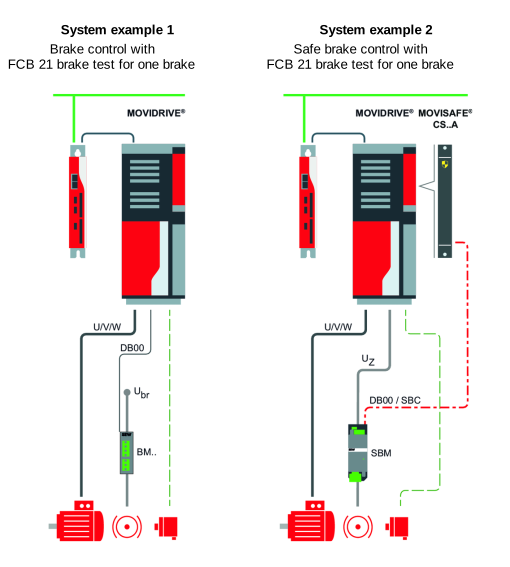

When 2 brakes are tested, they are tested separately. This requires additional wiring for separate control of the two brakes. System examples 3 and 4 show the additionally required relays K1 and K2. The "FCB 21 Brake test" alternately switches the two relays K1 and K2. This applies the brake to be tested while the other brake remains released. The wiring of the DB 0/DB 00 brake control must be routed to relays K1 and K2 via NC contacts (low-active).
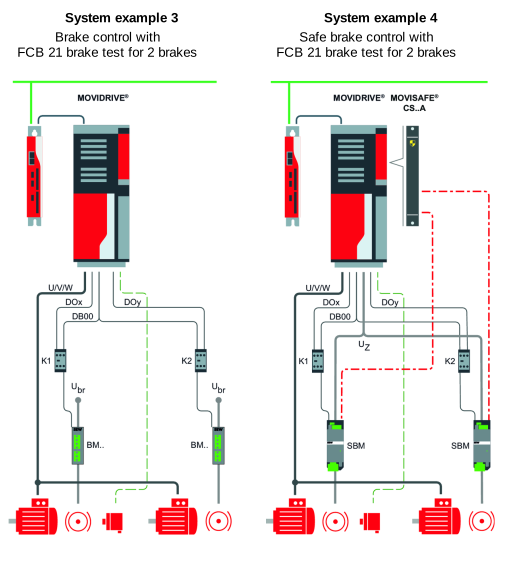
These additional control signals DOx and DOy can be freely assigned, e.g. to PI data, digital outputs, or the I/O extension of the inverter. SEW‑EURODRIVE recommends using the digital outputs of the inverter or the I/O extension.
Assign the following signals of FCB 21 to the required digital outputs:
- For brake 1 (DOx in the example): "FCB 21 Brake test – apply brake 1"
- For brake 2 (DOY in the example): "FCB 21 Brake test – apply brake 2"
For more information on configuring digital inputs/outputs, refer to chapter Digital inputs/outputs.
