Short circuiting the DC link
In order to work safely, SEW‑EURODRIVE recommends short-circuiting a discharged DC link for the duration of the work.
If an energy storage unit is connected to a DC link, short-circuiting the DC link is essential for safety reasons. This affects all types of energy storage units, e.g. double layer capacitors or MDC90A.. and MDC92A... capacitor modules
In the case of energy modules, a voltage can build up again after a discharge has taken place due to technological reasons. This is prevented by fitting the short-circuit jumper immediately after discharging.
If possible, use the short-circuit jumper for short-circuiting the MDC90A.. or MDC92A.. Fit the short-circuit jumper at a suitable location directly on the MDC90A.. or MDC92A.. capacitor module or a neighboring device.
The short-circuit jumper can be fitted to all devices in the MOVIDRIVE® modular series which are equipped with narrow DC link conductor rails with a width of 14 mm. If the conductor rails of the DC link on the MDC90A are removed, a short circuit must be made on the MDC90A.. and MDC92A.., see chapter Short-circuiting MDC90A.. capacitor modules and MDC92A.. energy modules.
Fitting the short-circuit jumper
- Discharge the DC link.
- Switch off the voltage supply of all devices on the DC link.
- Remove the conductor rail cover from the device.
- Measure the voltage of the DC link (+VDCL and -VDCL) directly at the conductor rails using a suitable measuring device. If the voltage is > 3 V, actively discharge the DC link or wait until the voltage has dropped below 3 V by itself. Observe the discharge times listed in chapter Discharge times of the energy storage units.
- Ensure that no voltage is present between +VDCL and PE, and between -VDCL and PE.
- Immediately after having measured that the DC link is de-energized, screw the short-circuit jumper to the DC link. The screw of the short-circuit jumper fits into the same thread that is present for attaching the cover which was removed in point 3. For devices with two stud bolts, make sure you only use the one on the left. The figure shows the permitted and the prohibited mounting position of the short-circuit jumper. When used on the device for the first time, the tightening torque is 0.6 Nm; for other applications it is 0.4 Nm.
- After completing the work, the short-circuit jumper must be removed before switching on the devices, and the conductor rail cover must be re-attached.
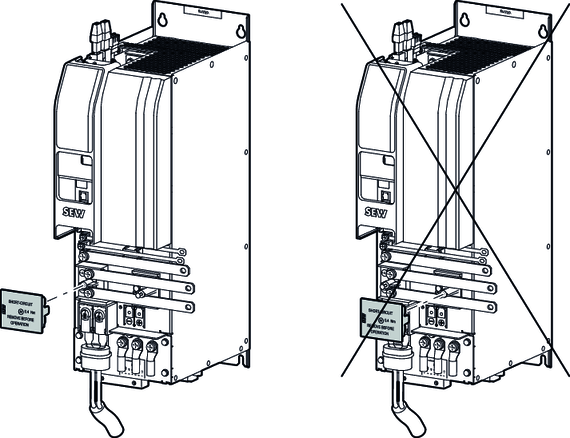

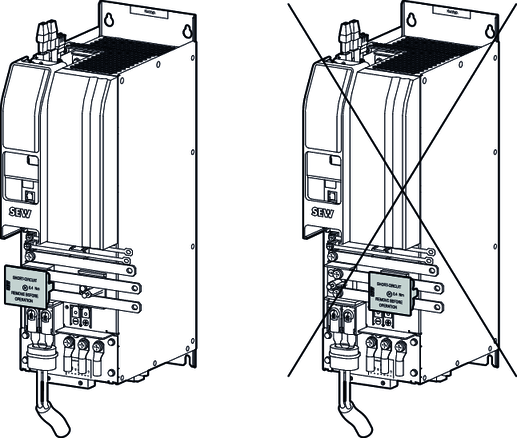
If necessary, the short circuit can also be made using an insulated wire with a minimum cross-section of 1.5 mm2.
