Brake test
INFORMATION

Contact the SEW‑EURODRIVE Service department to configure the brake test.
The "Brake test" additional function (operating modes 700-704) allows you to use the "FCB 21 Brake test" drive function. The drive function tests the functionality and performance of up to 2 brakes per axis group member by separately applying an adjustable torque (static test) to the applied brake(s).
The brake test can be adapted ideally to the requirements of the application. The test result "OK" (passed) and "NOK" (failed) and optionally other measured values are available as feedback for each brake.
An application-specific load torque must be taken into account when specifying the torque. The user can specify a value. As an alternative, the FCB 21 can determine the current load situation itself. This simplifies startup and offers more flexibility in the application.
FCB 21 works with drive train 1 (DT1). An encoder feedback (motor encoder or distance encoder) that matches the required VFCPLUS, CFC or servo control mode is required. When executing the FCB 21 brake test to test one brake, brake control is integrated via DB 0/DB 00.
Observe the following information regardless of the priority used:
- The brake test cannot be used in combination with the add-on MOVIKIT® MultiAxisController addon Cascading.
- One drive alone must be able to hold the application electrically and mechanically during the brake test.
- It is not possible to use several drives to apply the test torque.
Observe the following information when using the "Torque priority":
- In the inverters, in the "Drive functions" > "FCB 01 Output stage inhibit" configuration menu, activate the function "Release brake/deactivate Dynastop® with FCB 01 – enable".
- Perform referencing before the brake test when using a cycle time >1 ms.
Observe the following information when using the "Skew priority":
- Depending on the controller settings, the error windows, the configuration of the FCB 21 brake test, and the dynamics of the movement, slipping of the brake can lead to stresses in the structure.
- It is recommended to select a permitted movement for the FCB21 that is smaller than the lag error and skew error window.
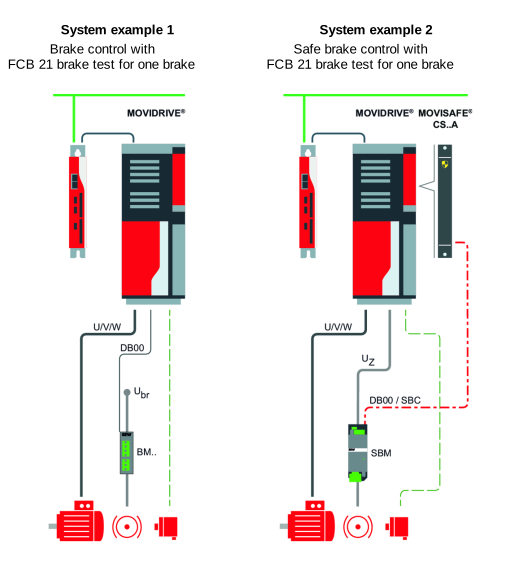

When executing the FCB 21 brake test to test two brakes on one axis group member, the twobrakes are tested separately. This requires additional wiring for separate control of the two brakes.
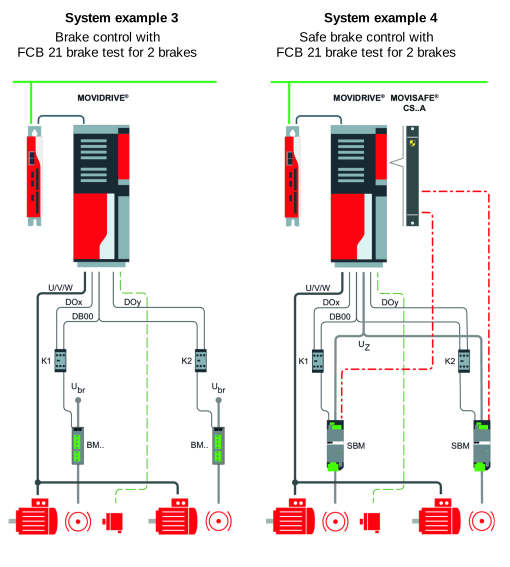
System examples 3 and 4 show the additional relays K1 and K2 required during brake control DB 0/DB 00. When the FCB 21 brake test is active, the two relays K1 and K2 are switched alternately by FCB 21. This applies the brake to be tested while the other brake remains released. The wiring of the brake control DB 0/DB 00 must be routed to relays K1 and K2 via NC contacts (low-active).
Relays K1 and K2 are controlled by FCB 21 via control signals. These can be freely assigned, e.g. to process input data, digital outputs or I/O extension of the inverter. SEW‑EURODRIVE recommends using the digital outputs of the inverter or the I/O extension.
Assign the following signals of FCB 21 to the required digital outputs:
- For brake 1 (DOx in the example): "FCB 21 Brake test – apply brake 1"
- For brake 2 (DOY in the example): "FCB 21 Brake test – apply brake 2"
Operating mode 700 for testing the brakes of all axis group members and operating modes 701-704 for testing the brakes of an individual axis group member are available for starting the brake test.
