Selection of the compensation priority
Selecting the appropriate compensation priority for certain applications is explained below using an example.
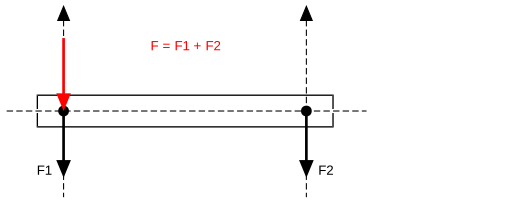

At 2 motors rigidly coupled via a beam (shown as a dot in the figure), an external force (F) acts on motor 1. Due to the rigid coupling of the motors, motor 2 must compensate part of the force acting on motor 1. The ratio between the force acting on motor 1 (F1) and the force acting on motor 2 (F2) is therefore decisive for selecting the compensation priority.
The following table shows which compensation priority is suitable for which force ratio:
Force ratio F1/F2 | Priority of compensation |
|---|---|
0 to 0.1 | Skew |
0.1 to 0.25 | Determine the operating mode using a test |
0.25 to 1 | Torque |
This means that the priorities are suitable for the following applications:
Torque priority
- Indexing table
- Extruder
- Calenders
- Vehicle
- SRS units with cornering ability
- Port crane
- SRS anti-sway drive
- Gripper
- Centering unit
- Sheet metal coil
- Tubular bag feed
Skew priority
- Port crane
- Gantry crane
- Indoor crane
- Gantry
- Dual-column hoist
- Parallel feed
- Pallet transfer shuttle
Not supported:
- Cam switch (decentralized solution required for the inverter)
- SRS units with cornering ability, asymmetrical velocity/speed control (not yet available)
- Torque control in the inverter (not possible)
- However, many applications that were previously operated in this control mode can be implemented with the “Torque” compensation priority using the MultiAxisController, provided the dynamics of the MultiAxisController are sufficient.
- Joining processes that were previously carried out using the "Positioning with torque limiting" function can now also be carried out with the software module. The software module, however, cannot be limited to the sum of the axis group members; instead, each axis group member has to limit itself separately.
