Data container(s)
The data containers for collecting data from devices and device options are added and managed on the "Data containers" tab. The list also contains the data containers added via libraries.
Data containers are used, among other things, to specify the linked device groups (assignment of individual devices not possible), the data type (parameter or scope data), the update strategy (cyclical or triggered), the recorded parameters or recording channels, and the endpoints for saving the data. The software can run several data containers in parallel.
Each data event (parameter acquisition, scope recording) is stored separately in a JSON file. Each data container type has its own JSON file format, and a separate directory is created at the assigned endpoint for each instance of the software. The JSON files are assigned via a generated ID. For further information, refer to chapter Output format.
Information on the collected data volume at field level (OT network) and the transferred data volume (IT network) is displayed below the data containers. See Data volume and memory requirements.
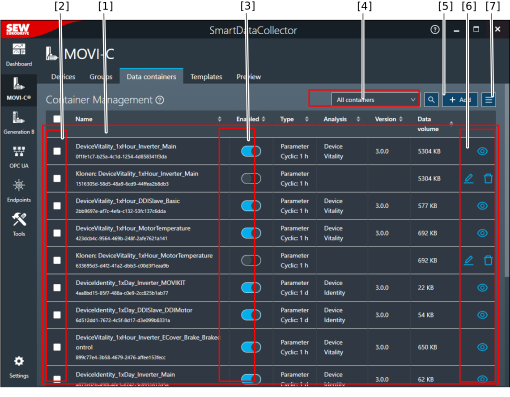

[1] | Created data containers with name, type, analysis method, version, and monthly data volume (data container data × number of devices in the group × update interval). |
[2] | Select data containers for further processing [7] |
[3] | Enable or disable a data container |
[4] | Functions for filtering the displayed data containers |
[5] | Add a new data container |
[6] | Edit and/or delete a data container INFORMATION: Objects that cannot be edited and/or deleted (read access only) are indicated by an "eye" icon. However, it is possible to create a copy of these objects. |
[7] | Advanced functions (including import/export, enable/disable data containers, enable/disable data container endpoints, publish data containers as a library, reset data containers to library state) |