Torque between axis group members
The torque between axis group members is particularly important when tensioning chains, clamping workpieces and minimizing slack. In contrast to the torque ratio function, the torque between the axis group members has the advantage that it is also effective at idle state (setpoint torque required by application 0 Nm).
The torque between 2 axis group members is explained in detail below by means of the schematic view of a gear wheel driven by 2 axis group members:
Example 1: 0% tension
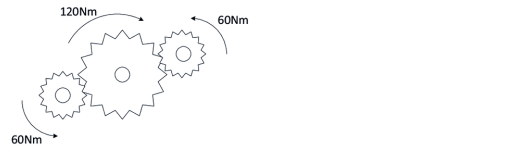
If the tension between the axis group members is set to "0" and a setpoint torque of 120 Nm is required, both axis group members will deliver 60 Nm each:
- Setpoint torque required for the application: 120 Nm
- Nominal torque of drive 1 (60 Nm) and drive 2 (60 Nm): 120 Nm

Example 2: 50% tension
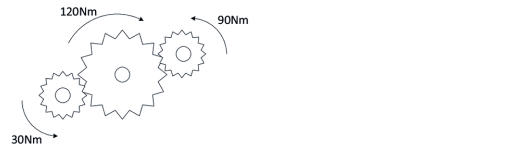
However, if a tension of 50% is set between the axis group members instead, the following torques would result:
- Setpoint torque required for the application for axis group member 1 (-25% nominal motor torque): -30 Nm + 60 Nm = 30 Nm
- Setpoint torque required for the application for axis group member 2 (+25% nominal motor torque): 30 Nm + 60 Nm = 90 Nm
- Resulting torque difference as tension: 60 Nm
- Setpoint torque required for the application: 120 Nm
- Nominal torque of drive 1 (30 Nm) and drive 2 (90 Nm): 120 Nm
Example 3: -50% tension
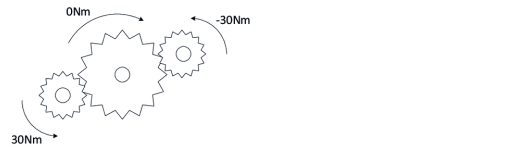
The direction of the tension is indicated by the sign of the tension. If a value of -50% is set for tension without load, the 1st axis group member would deliver -30 Nm and the 2nd axis group member would deliver 30 Nm:
- Setpoint torque required for the application: 0 Nm
- Nominal torque of drive 1 (30 Nm) and drive 2 (-30 Nm): 120 Nm