Operating principle
When larger masses are lowered, e.g. in stacker cranes, a lot of potential energy is released. Without adjusting the setpoint for the state of charge, the connected energy storage unit would be precharged to a very high value by the connected power supply module. This prevents regenerative energy from being absorbed by the lowering lifting axes.
To relieve the energy storage unit during upward travel movements, the "height-dependent charge control" function dynamically adjusts the setpoint of the energy storage unit based on the current position of the lifting axis:
- When the lifting axis moves upwards, the state of charge setpoint is gradually reduced so that capacities are kept available in the energy storage unit to absorb the resulting recuperation energy.
- When the lifting axis moves downwards, the state of charge setpoint is increased again until it reaches the original "stationary" setpoint again at a defined zero point.
In the following example, the maximum reachable height of the hoist is 40 m ("Highest position of hoist" parameter). The zero position and consequently the lowest position is 0 m ("Lowest position of hoist" parameter).
The operating range of the Power and Energy Solutions system is defined between 720 V and 480 V. The stationary state of charge setpoint parameterized via the "Target charge level" parameter of the "Automatic" operating mode is 700 V.
The hoist is positioned at its defined zero position. The current setpoint is therefore the stationary setpoint of 700 V because no recuperation energy is expected.
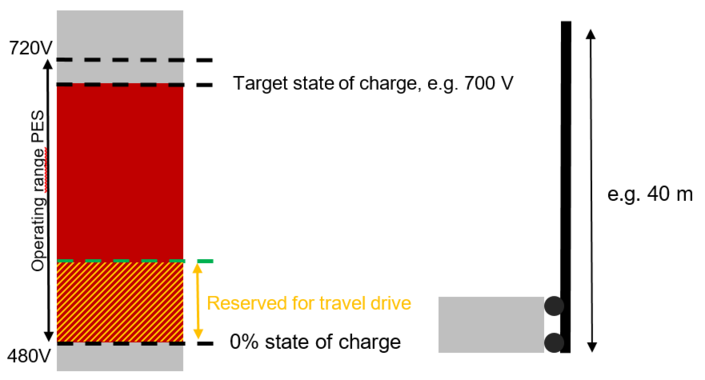

The hoist is now moved to its maximum height of 40 m. The target state of charge has now been reduced until it reaches the value of the reserve state of charge specified by the "Reserve for further drives" parameter. This means that the storage unit still has residual charge that can be used by other drives if the supply power is lower than the power currently required by the drives.
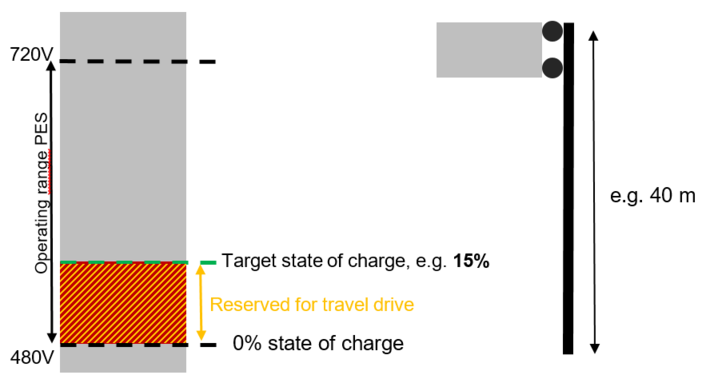
Energy interpolation is now performed between these two state of charge levels, i.e. for positions between zero position and maximum position, a state of charge setpoint is output that corresponds to the energy between these two levels.
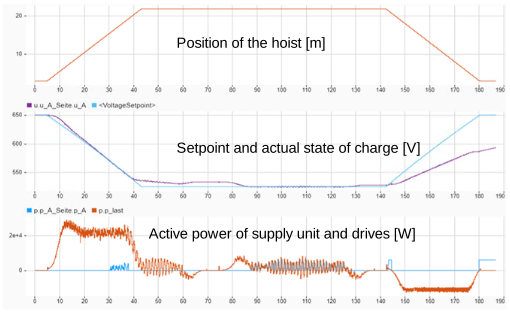
The following figure shows a travel process of a storage/retrieval system. The hoist is moved from 0 m to approximately 21.8 m and is lowered again at the end of the travel process. The state of charge setpoint is changed dynamically between approximately 650 V and 525 V based on the position information of the axis.