Layer structure
EtherCAT® is used for the exchange of synchronized and non-synchronized process data. Acyclic services can also be carried out with EtherCAT®.
In order to perform the basic functions of data exchange, the EtherCAT® protocol builds hierarchically on layer 1, layer 2 and layer 7 of the ISO/OSI model. In order to establish IP communication between the stations, the protocol can be extended by further layers.
One or more Ethernet frames are available for communication. The user data of the Ethernet frame is divided into one or more EtherCAT® datagrams. Each datagram in turn contains the data of a physically available device or several devices.
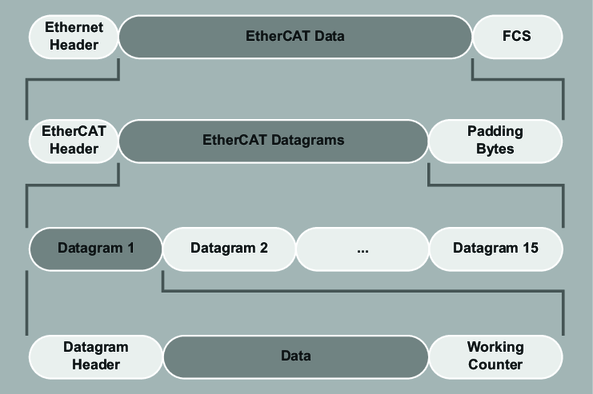

Since the IP header for communication is omitted here, the telegram itself can be kept very streamlined even with a small user data width.
For safety-related FSoE data, the EtherCAT® master reserves an area in the EtherCAT® datagram that is filled by the FSoE master and the FSoE slaves.
