Adding scope containers
INFORMATION

As the scope recorder of the inverter can only be used by one instance at a time, multiple scope recordings are not possible simultaneously. If a scope recording has already been started by MOVISUITE®, the software will overwrite this access. However, it is possible to use the container to control several devices at the same time.
Scope containers allow access to scope recordings from the inverter. For this purpose, the software controls the scope recorder of the inverter (prerequisite: Scope recorder version 2.1 or higher) (start, extract data) and cyclically checks whether data from a new scope recording is available. The scope template used can be configured directly in the software or imported from the inverter or a scope template file.
To add a scope container, proceed as follows:
- At least one device group and one endpoint have been created.
- Open the "Containers" tab.
- Click [+ Add].
- The "Container configuration" dialog window opens.
- The container can be configured via the following setting fields:
Setting field | Description |
|---|---|
Name | Enter a name for the container. The name is used in the tool configuration process and in the file structure when storing the JSON files. |
Identifier (ID) | Unique identifier of the container that is generated automatically by the software and used internally for further processing. This identifier forms part of the name of the target directory at the associated endpoint. |
Container description | Add optional description text. The description text is displayed under the "Containers" tab. |
Data collection | |
Container type | Select the container type. For a scope container, select the value "Scope". The relevant fields for the scope container are then displayed in the dialog window. |
Scope platform type
INFORMATION: Available in MOVI-B devices only. | Select the scope recorder for the scope recording. The settings for the recording channels and the trigger are adjusted accordingly. |
Enable container: Data container is collecting data | Activate the recording of data by the container immediately after saving the container configuration. |
Update strategy | Specify the update strategy of the container:
|
Update interval | Specify the update interval for cyclic data acquisition. The update interval describes the time between two successive cycles. Each cycle consists of reading and transferring data and takes about 100 ms. For example, an update interval of 5 ms results in a cyclical output interval of approx. 105 ms. The maximum value for the update interval is 31 days. |
Device groups | |
Assigned device groups | Select the device groups for data acquisition. All groups created under the "Groups" tab are available here. |
[+] button | Create a new group and assign it to this container. |
Transmission | |
Transmit the data packages to endpoints. | Activate or deactivate data transmission from this container to the selected endpoints. |
Endpoints for transmitting data packages | Select one or more of the configured endpoints as the storage location for the recorded data. All entries created in the "Endpoints" menu are available here. |
Templates | |
Use container template | Activate inheriting the entire data model from container templates. After activation, the "Included container templates" edit box for selecting the container templates is displayed. The loaded recording channels are automatically synchronized with changes in the template and cannot be edited as long as inheriting is activated. |
Included container templates | Select one or more container templates to inherit the entire data model configured in them. All templates created in the "Templates" menu and templates from installed libraries are available here. |
[Reload template] button | Reset the configuration of the container to the configuration of the specified template. |
Scope configuration | |
[Import] button INFORMATION: Only visible if "Inherit from container template" is deactivated. | Import a complete scope configuration from a MOVISUITE® MES or an XML file or from a switched-on device. For further information, refer to chapter Scope configuration. |
Sample rate | Specify the time interval between successive data samples. |
Post-trigger recording | Specify the percentage of the available recording buffer that should be filled with pre-recorded samples when the scope is triggered. INFORMATION: If the option "Discard MOVI-B and MOVI-C® scope container events if sample count is incomplete" is activated in the settings and a trigger has been configured for which data acquisition is directly active, the data of the 1st trigger event is discarded. Setting the value 100% also results in data loss. |
Application index INFORMATION: Available in MOVI-C® devices only. | Set the operating mode of the scope recorder.
|
Memory optimization INFORMATION: Available in MOVI-C® devices only. | Activate or deactivate optimization of memory usage. |
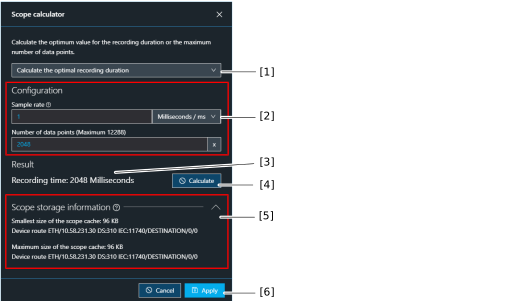
Limit of the number of data points INFORMATION: Available in MOVI-C® devices only. | Specify whether the number of data points should be limited. If you select "No limit", the scope cache is written completely. If you select "Strict limit", the "Maximum number of measuring points" field and the [Calculator] tool are displayed and the scope cache is only partially written according to the specified number. |
Maximum number of measuring points INFORMATION: Only visible if the "Strict limit" option is selected for "Limit data points". | Specify the maximum number of measuring points. A "calculator" is available for calculating the optimum value for the recording time or the maximum number of data points. |
[Calculator] button INFORMATION: Only visible if the "Strict limit" option is selected for "Limit data points". | Calculate the optimum value for the recording time or the maximum number of data points. For further information, refer to chapter Scope calculator. |
Recording time (estimate) | Generated estimate of the minimum recording time in milliseconds in accordance with the configuration above. |
Recording channels (INFORMATION: To save data, avoid assigning recording channels to more than one container.) | |
[+ Add one] button | Open the "Channel" dialog window to configure and add a scope channel. In the "Channel" dialog window, set the scope channel by specifying the index, subindex, name, and channel offset, or by selecting an entry from the "Available channels" list. By activating the "Only supported" check box, only parameters that can be used as a channel for a scope recording are displayed in the "Available channels" list. The added channels can then be re-sorted in the list of recording channels using the corresponding buttons. |
Function in the [Import scope channels from JSON file] submenu | Add scope channels by importing a JSON file or a CSV file exported from Excel, for example. |
Function in the [Export scope channels to JSON file] submenu | Export the currently created scope channels as a JSON file. |
Function in the [Import channels from container template] submenu | Import scope channels for data acquisition from a container template. Changes in the container template are automatically applied to the container. |
Trigger settings | |
Trigger delay mode | Set the delay for a configured trigger.
|
Trigger delay time | Set the delay for the configured trigger. |
Activate trigger #1-#3 | Activate the desired number of triggers and use the choice boxes that appear to specify the channel name and the trigger type. Decimal and hexadecimal values can also be entered in the "Compare value" edit box. Hexadecimal values require the prefix "0x". |
Linking triggers INFORMATION: Available in MOVI-C® devices only. | Connect multiple scope triggers to one another by using Boolean operators. |
Metadata | |
Extended information about the container. This metadata is transferred within the metadata section of the data event. The scope hash depicts the entire configuration of the container or the container template in a string. After changing the configuration, the scope hash must be updated by clicking [Calculate]. | |