Hysteresis around the switching point
To prevent the output from bouncing when the signal is fluctuating, a hysteresis can be defined around the switching point.
Switch-on
hysteresis
The switch-on hysteresis causes the cam to switch off again only when the source signal moves in the opposite direction by more than the hysteresis.
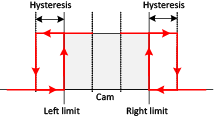

The switch-on hysteresis is activated if no switch-off hysteresis is active and the source signal reaches a cam limit from outside. It is deactivated when the source signal has left the cam limit ± hysteresis range.
Switch-off
hysteresis
The switch-off hysteresis causes the cam to switch on again only when the signal moves in the opposite direction by more than the hysteresis.
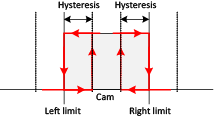
The switch-off hysteresis is activated if no switch-on hysteresis is active and the source signal reaches a cam limit from inside. It is deactivated when the source signal has left the limit ± hysteresis range.
