General
A cam switch can be used to control actuators or machine sequences during a motion sequence depending on a data source (e.g. from a physical encoder). The cam switch function of the software module digitally simulates a mechanical cam switch.
A cam switch can consist of several cam tracks. Each cam track is assigned a binary switching signal. A cam track is divided into cam windows. A cam window is a value range or a defined switching point where the switching signal of the cam track assumes a defined value.
Each cam track generates a binary switching signal that is set as soon as the signal is within one of the assigned cam windows or the limit of a time cam is reached. The cam tracks are processed with the cycle time set in the MOVI-C® CONTROLLER. This cycle time is at least 1 ms. The switching signal can be output at a digital output of a connected periphery.
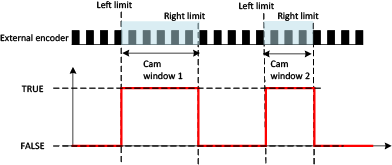

The following data sources can be processed:
- Actual position of an external encoder
- Actual position of an axis
- Setpoint position of an axis
- Any signal generated by the user (e.g. fill level, flow rate, motion profile)
To calculate the correct switching point taking into account a dead time, the derivations of the signal are required. The derivation is also provided by the data sources.
