EtherCAT® State Machine (ESM)
The slaves pass a state machine, referred to as EtherCAT® state machine (ESM). The state machine allows the stations in the network different functions in the respective ESM states. The master sends requests to the slaves and the slaves have to confirm them in order to fulfill the transition conditions of the ESM states.
At the start, master and slaves are in "Init" ESM state. Communication in the network takes place in "operational" ESM state.
The figure below shows a simplified EtherCAT® state machine (without start routine) and the functions assigned to the various states.
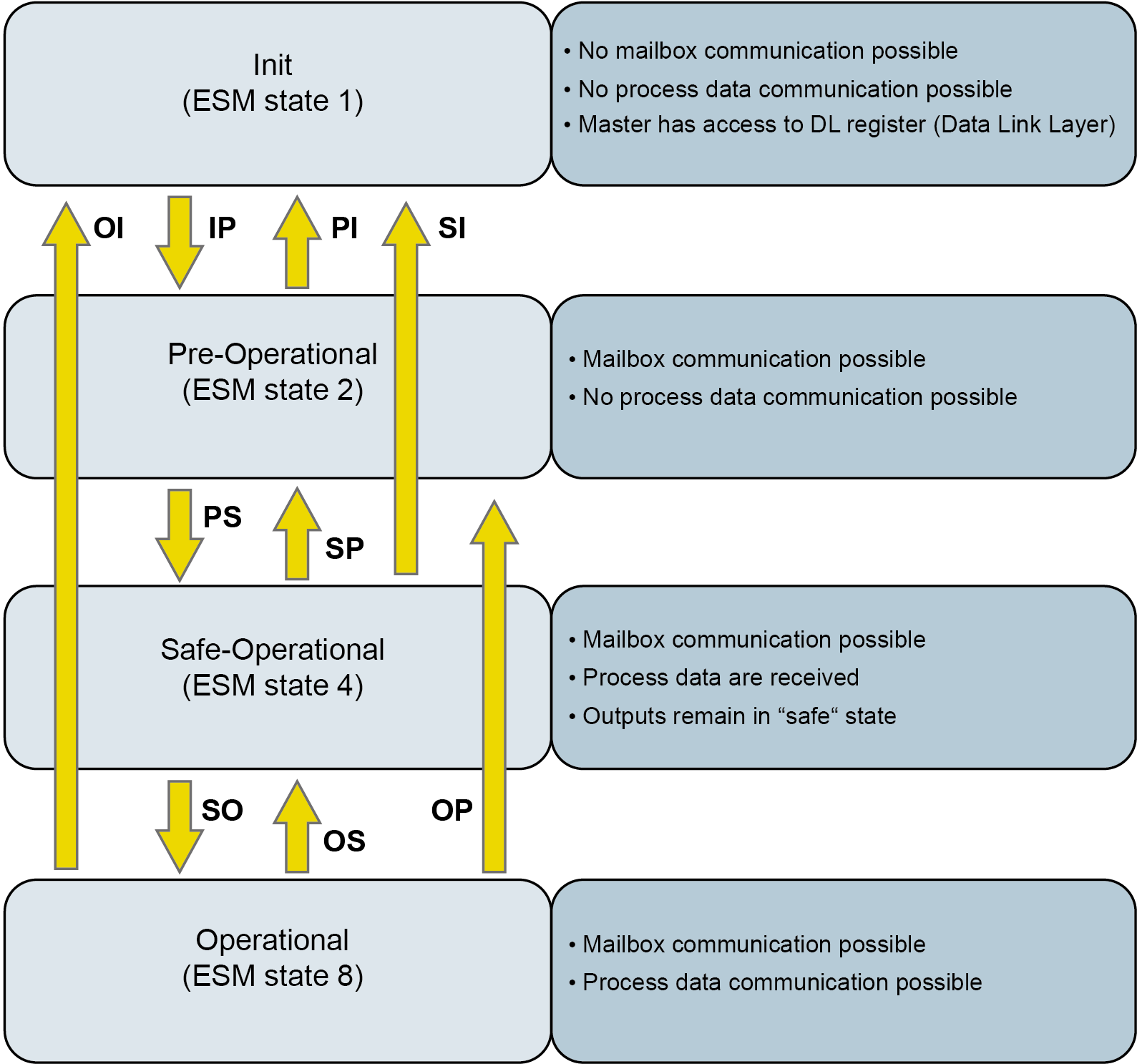

The master writes ESM requests, such as a change of state or error acknowledgement, into the "AL control register" of the slave controller (ESC). When the requests are acknowledged, the slave sets the AL status register to "acknowledge". If not, the slave sets the AL status register to "false" and enters an error code in the AL status code register. These registers are important for diagnosing network problems and for locating slave errors.
