MOVI-C® CONTROLLER
The MOVI‑C® CONTROLLER control family is characterized by a variety of performance classes and a suitable housing shape for every task. It ranges from a high quality cell controller to sophisticated automation control.
The MOVI‑C® CONTROLLER comprises 4 performance classes in the following variants:
- MOVI‑C® CONTROLLER performance class "standard" is a compact profile rail controller. It is optimized for coordinated two-axis applications (2 interpolating axes) paired with an additional 6 auxiliary axes.
- The MOVI‑C® CONTROLLER performance class "advanced" is suited for automating machines and cells for up to 8 interpolating axes and 8 auxiliary axes depending on the size of the application program. It can be used as a module controller for complex motion functions, such as electronic cams and robotics.
- This controller also optionally offers installation in a master module that can then be installed as a module within the MOVIDRIVE® modular series in an axis system. This can result in additional wiring advantages.
- The MOVI-C® CONTROLLER performance class "progressive" is suited for automating machines and cells for up to 16 interpolating axes and 16 auxiliary axes depending on the application program. It is suitable as a module controller for complex motion functions such as electronic cams and robotics, as well as for the complete automation of machines and systems.
- The MOVI‑C® CONTROLLER performance class "power" is also designed as industry PC. It is optimized for coordinated applications for up to 32 axes (interpolating axes) paired with an additional 32 auxiliary axes. Furthermore, a second operating system, running separately from the real‑time PLC via modern Hypervisor technology, can be optionally activated on this controller, e.g. for integrated visualization. Workload spikes in the real-time PLC or the second Windows® Embedded Standard 7 operating system have no influence on the respective other side.
Difference between interpolating axes and auxiliary axes:
- With interpolating axes, the motion profile is calculated cyclically in the controller and is transmitted to the inverter via process data. The inverter then follows this cyclical setpoint by interpolation. The use of this operating mode ranges from coordinated positioning and electronic cams all the way to robotics.
- By contrast, auxiliary axes operate autonomously when it comes to the motion profile. Setpoints, such as a target position, are transmitted to an auxiliary axis, which then approaches this target independently. This operating mode is suitable for single-axis applications, e.g. positioning, speed or torque control tasks.
|
|
|
|
MOVI‑C® CONTROLLER ... | |||
standard UHX25A | advanced UHX45A | progressive UHX65A | power UHX85A |
|
|
PC-based |
PC-based Optional 2nd WIN7 operating system embedded |
Allocated to MOVIRUN® ... | |||
smart/flexible | smart/flexible | flexible | flexible |
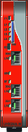
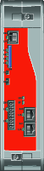

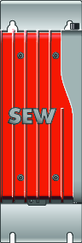
All 4 controller classes can be optimally embedded in the system from SEW‑EURODRIVE and have the following in common:
- Modern, clock-synchronized EtherCAT®/SBusPLUS system bus master for the interface to the inverters and peripherals from SEW‑EURODRIVE.
- Connection to conventionally available higher-level controllers via standard fieldbus-slave interface connections such as PROFIBUS, PROFINET, EtherNet/IPTM and Modbus TCP.
- Ethernet engineering interface with routing function to subordinate devices from SEW‑EURODRIVE that are connected to the system bus.
- Common software world for engineering, programming, diagnostics, the MOVIRUN® software platform and the MOVIKIT® software modules.
- Freely programmable sequence control in accordance with IEC 61131 for automating drive and logic tasks (MOVIRUN® flexible).
- Central data storage for all MOVI-C® inverters from SEW‑EURODRIVE.
- Plug-and-play device replacement through automatic data restoration.
- Routing of conventional security protocols from higher-level controllers to the drive inverters. In the first step, PROFIsafe was implemented via PROFINET.
