Determining stiffness
The configuration of some application types (e.g. tower sway and belly sway) requires the definition of the parameters "Spring stiffness between tower and vehicle" and "Damping ratio between tower and vehicle". If you do not already know these values, e.g. from the mechanics simulation, they can be determined from the signal course of the oscillating system.
- Activate the "Support for parameter determination" function in the "Basic settings" area in the "Anti-sway control" configuration menu.
- Load your application with the required payload and move the lifting axis to the position where the greatest oscillation of the tower occurs. With the "Tower sway" application type, for example, this is most often the highest point on the tower, and with the "Belly sway" application type in the middle of the tower. If necessary, update the value for the "Distance between trolley and vehicle" parameter. If the application does not allow it to move to the recommended position without anti-sway control, the oscillation can also occur at a lower lifting height or with less load. Update the parameters accordingly.
- Deactivate the anti-sway control to measure the oscillation by selecting the "Anti-sway control off" setting as the "Application type" or switch the anti-sway control off and on via the fieldbus interface in the optional process data under anti-sway control using the control word.
- Run the application and record the amplitudes of the oscillating system, e.g. by means of a video recording at the point of greatest oscillation. If there is enough torque back to the motor from the oscillating mass, a scope recording of the torque can also be used.
- Determine the 3 parameters shown below on the basis of the recordings. The peaks of the oscillation amplitudes can be specified proportionally to one another even independently of their amplitude (e.g. 1 : 0.8). The "Oscillation period" can also be determined across multiple periods (e.g. measured time / number of oscillation periods)
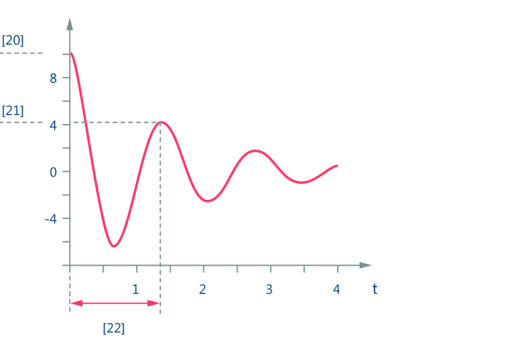

[20] | Oscillation amplitude (1st peak) |
[21] | Oscillation amplitude (2nd peak) |
[22] | Oscillation period (time between 1st and 2nd oscillation amplitude) |
- Reactivate the anti-sway control by selecting your application type. Check the "Name of the axis for lifting position" setting if you are using the "Tower sway" application type.
- Enter the determined measured values (see diagram) into the corresponding setting fields in the "Anti-sway control" configuration menu.
- The values "Damping ratio between tower and horizontal drive" and "Spring stiffness between tower and horizontal drive" are calculated and used directly for the anti-sway control.
- The natural frequency, resonant frequency and "Deflection at lifting height" are determined for plausibility checks against reality and design calculations.
- Run a plausibility check with the aid of the "Deflection at lifting height" value in the "General information for assessing the design" area in the "Anti-sway control" configuration menu.
- Deactivate the "Support for parameter determination" if the "Distance between trolley and vehicle" or "Mass of the payload" parameters are used for operating the application.
