Adding parameter containers
Parameter containers allow access to one or more individual device parameters and the integrated device options (subcomponents). The data can be retrieved by a manual trigger or automatically (cyclically).
To add a parameter container, proceed as follows:
- At least one device group and one endpoint have been created.
- Open the "Containers" tab.
- Click [+ Add].
- The "Container configuration" dialog window opens.
- The container can be configured via the following setting fields:
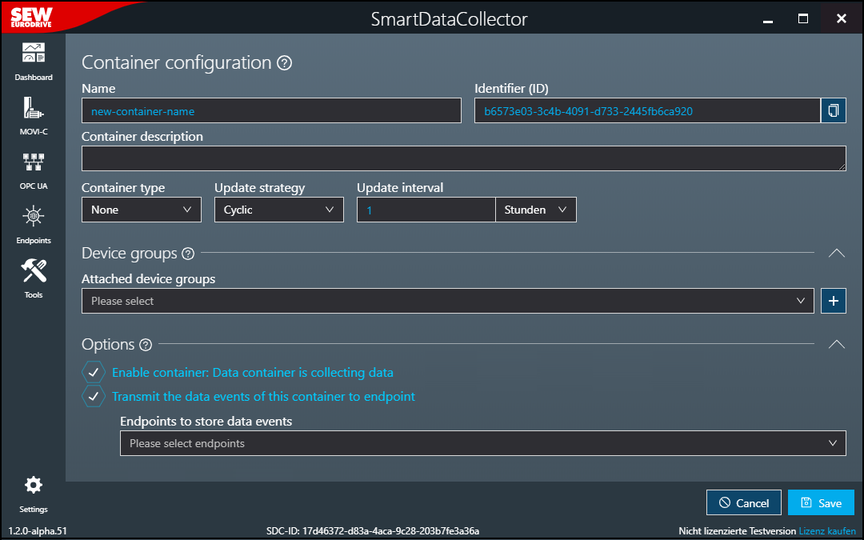

Setting field | Description |
|---|---|
Name | Enter a name for the container. The name is used in the tool configuration process and in the file structure when storing the JSON files. |
Identifier (this is generated) | Unique identifier of the container that is generated automatically by the software and used internally for further processing. This identifier forms part of the name of the target directory on the associated endpoint. |
Container description | Add optional description text. The description text is displayed under the "Containers" tab. |
Container type | Select the container type. For a parameter container, select the "Parameter" value. The relevant fields for the parameter container are then displayed in the dialog window. |
Update strategy | Specify the update strategy of the container:
|
Update interval | Specify the update interval for cyclic data acquisition. The update interval describes the time between two successive cycles. Each cycle consists of reading and transferring data and takes about 100 ms. For example, an update interval of 5 ms results in a cyclical output interval of approx. 105 ms. The maximum value for the update interval is 31 days. |
Device groups | |
Assigned device groups | Select the device groups for data acquisition. All groups created under the "Groups" tab are available here. |
[+] button | Create a new group and assign it to this container. |
Options | |
Enable container: Data container is collecting data | Specify whether the recording of data by the container is activated immediately after saving the container configuration. |
Transmit data events of this container to endpoint | Activate or deactivate data transmission from this container to the selected endpoints. |
Endpoints to store data events | Select one or more of the configured endpoints as the storage location for the recorded data. All entries created in the "Endpoints" menu are available here. |
Inherit from container template | Activate the inheritance of the data model of a configured container template. Changes in the container template are automatically applied to the container. The "Inheriting container templates" edit box for selecting the container template is displayed. |
Inheriting container templates | Select one or more configured container templates to inherit the data model specified in them. All entries created in the "Templates" menu are available here. The parameters contained in the selected container template are added to the "Entered parameters" area, but cannot be edited there. |
Entered parameters (INFORMATION: To save data, make sure that a parameter is not added to more than one container) | |
[+ Add one] button | Add one parameter for data acquisition. |
[+ Add multiple] button | Add multiple parameters simultaneously for data acquisition. |
Function in the [Import parameters from JSON file] submenu | Add parameters for data acquisition by importing a JSON or a CSV file exported from Excel, for example. See also Parameters. |
Function in the [Export parameters to JSON file] submenu | Export the currently created parameter list for data acquisition as a JSON file. See also Parameters. |
Function in the [Import parameters from container template] submenu | Import parameters for data acquisition from a container template. Changes in the container template are not automatically applied to the container. |
Estimates of data transfer and volume | |
Estimation of the collected data volume at field level (OT network) and the transferred data volume (IT network) | |
