Operating principle
The StorageDischarger operating mode discharges the DC link and stops automatically when the measured voltage drops below the target voltage. The function block sends a pulse width modulation signal (PWM signal) to the MOSFET (metal-oxide semiconductor field-effect transistor) of the braking resistor on the MDP92A power supply module so that the selected discharging capacity is not exceeded. The frequency of the signal is 1 Hz. From a certain point onward, the residual voltage is so low that the MOSFET is continuously activated and the discharging capacity decreases.
If the target voltage has been reached, the PWM signal is switched off and the operating mode signals back that the discharge process has been terminated using the "Target voltage reached" feedback. An estimated discharging time is displayed during discharging.
Special case: If 0 V is entered as target voltage and a residual voltage of approx. 1 V has been reached, the operating mode signals "Target voltage reached" as feedback. In this case, the braking resistor remains permanently connected to the DC link until the operating mode is no longer active (xStart = "FALSE").
INFORMATION

If "Target voltage reached" is signaled as feedback, the residual voltage has to be checked. Observe the safety note at the beginning of this chapter.
If the voltage is very high, or the resistance is very low, or the maximum continuous power of the connected resistor is very low, the smallest achievable PWM profile may cause the power in the resistor to increase more than intended for a given cycle time. A message is displayed if the currently achievable discharging capacity is at least 10% higher than the setpoint charging power, and discharging is aborted..
The following graphic shows a complete discharging process for the DC link. The DC link voltage is 650 V when the discharging process starts, the target voltage is 50 V and the maximum discharging capacity is 3 kW.
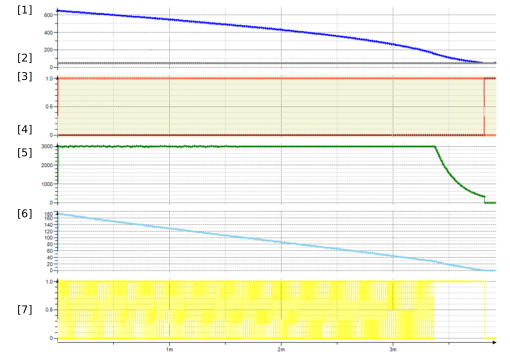

[1] | DC link voltage | [5] | Current discharging capacity |
[2] | Discharging voltage | [6] | Remaining discharging time |
[3] | Discharging active | [7] | PWM profile |
[4] | Discharging finished |
|
|
Explanation of the diagram:
The diagram shows a constant discharging capacity of 3 kW, which decreases after slightly over 3 min, when the residual voltage is too low to produce 3 kW in the discharge resistor. From this point on, the PWM profile switches on the discharge resistor continuously. From the point in time at which the setpoint voltage is undershot, the PWM profile switches off again and signals "Target voltage reached" as feedback.
