Multi-counter
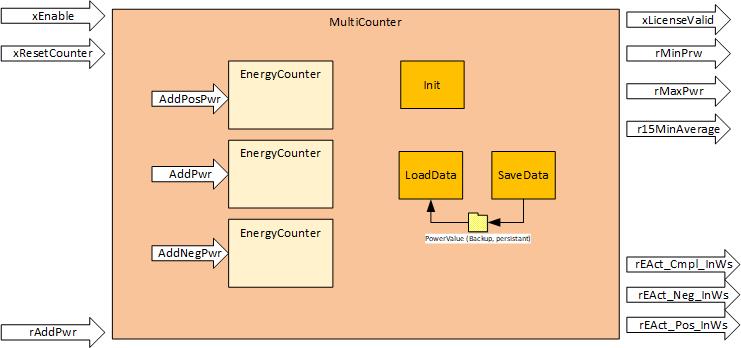
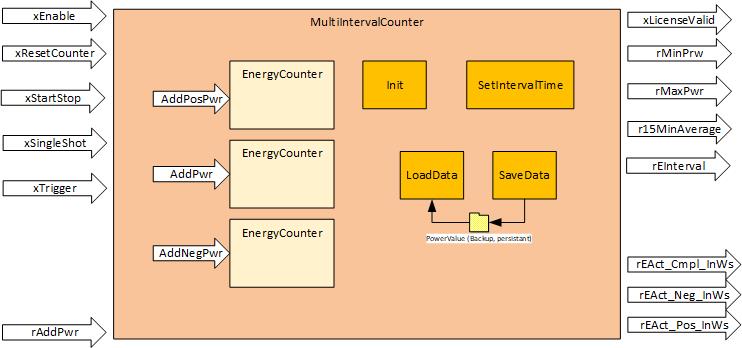
“Multi-counters” are energy meters that contain 3 single counters. One single counter counts positive, one negative, and one bidirectional. The energy balance, energy consumption and energy flow are always available separately from each other via the values of the 3 single counters. The 3 single counters can be initialized with energy values stored in the non‑volatile memory.
"Multi-counter" energy meters can store the determined values in the persistent memory on the memory card. If the energy values are initially set to 0 and a file name is transferred during initialization, an attempt is made to start with the stored value. If the file does not yet exist, it is created and filled with the actual values (usually 0). If the energy values are initially not equal to 0, they are used and the value stored in the file is not taken into account.
For operation, "Multi-counter" energy meters have the LoadData and SaveData functions. While the LoadData function overwrites the actual values with stored values, the SaveData function saves the current values on the file on the memory card (only one data set is saved). The data is not saved automatically but must be explicitly saved by running SaveData in the application program. A power failure is not covered by this function. In this case, there is the option of creating the run variables in the retain memory.
In addition to simple energy metering, "multi-counter" energy meters provide the following additional power analyses:
Min./max. power
Measurement and output of minimum and maximum power value (absolute). The two values are determined only if the energy meter is running at the same time (the xRunning variable has the value "TRUE"). For example, if the power is between -5 kW and 7 kW, the -5 kW is output as the minimum value and the 7 kW as the maximum value. The determined values are retained until the next recording, initialization or reset.
15 min. mean value
The 15 min. mean power value is determined and output. The 15 min. mean power value is a variable that can affect the electricity price.
The following method is used to limit the number of measured values (e.g. with a bus cycle of 1 ms = 900000 values):
- For example, the power values available in a 1 ms, 5 ms or 10 ms cycle are added to a variable and saved to a ring buffer once per second. The buffer holds 60 values, i.e. 60 s.
- The contents of the second ring buffer is totaled once per minute and divided by 60. This minute value is saved to the 15 min. ring buffer.
- The 15 min. ring buffer is analyzed every minute, at which time all 15 values are totaled and divided by 15. The result is then output and is current for one minute.